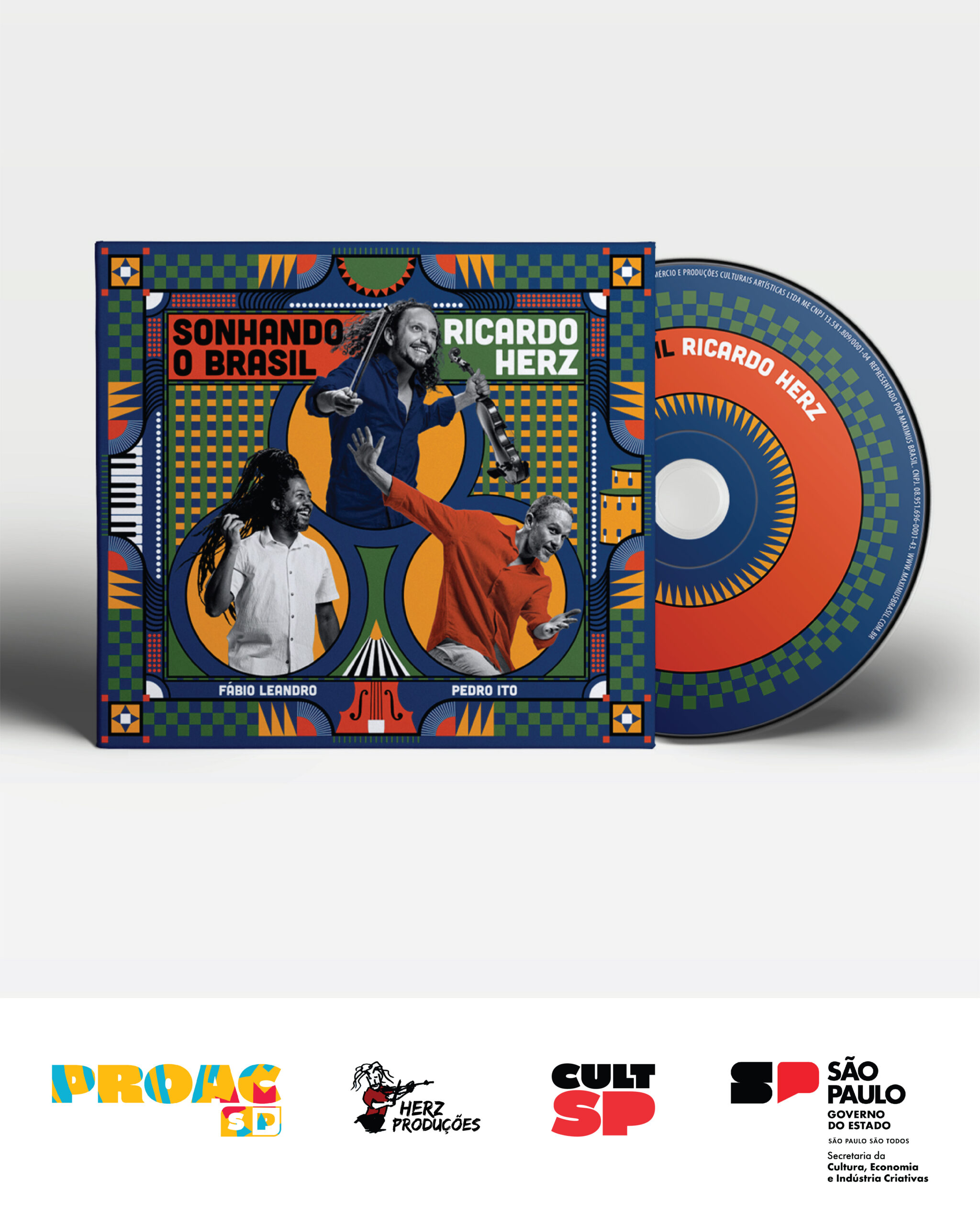
Album · 2024
Sonhando o Brasil
Ricardo Herz Trio
An album of original compositions that envisions Brazil through its rhythms, encounters, and possibilities.
Violin, piano/keyboards, and drums/percussion drive an expansive sound, featuring guest artists and ten tracks with commentary by the composer himself.
The album
About the album
Sonhando o Brasil It is a record that celebrates an imaginary country.
Our imagination draws heavily on reality, of course, but for this dream of Brazil, I chose the very best of what our country has to offer: joy, spontaneity, dance, melodies, affection, openness, generosity, and love.
In these crazy times we live in—both internally and externally—I hope my music is filled with that positive spirit, championing the celebration of life in community.
Long-time friends and new friends—all of them idols—took part in the album, coming together to make this dream record a reality.
It is also an album celebrating a 20-year career, dating back to my first solo record (Violino Popular Brasileiro – 2004).
Between that one and this one, I made nine other albums that transformed me greatly as both a musician and a person, as I played and learned alongside great artists and friends to whom I owe so much.
The pandemic transformed us all, too.
In my case, being at home with Vanille—my wife and partner, who is also a violinist and rabeca (traditional Brazilian fiddle) player (and with whom I have a duo)—gave me the chance to play and study extensively. I was able to delve into areas that only the absence of concert schedules and urgent deadlines allows for, working with great calm and long-term goals.
All of this is reflected in the new songs on this project.
Even while staying true to my own style and signature sound, with every step I take, I carry the full baggage of experiences I’ve gathered along the way.
“Sonhando o Brasil” was a handcrafted process from start to finish: project writing, songwriting, demos, rehearsals, conceptualization, recording, cover art, mixing, editing, mastering, videos, and production.
Everything was done with great care and affection by everyone involved—to whom I offer my heartfelt thanks.
Happy listening, everyone!
Let’s dream—and build—a better Brazil and a better world!
Ricardo Herz
Acknowledgments:
So many people were part of this process, contributing love, time, patience, and talent.
I’ve listed everyone from the credits below and want to thank them all again.
My thanks to my family, who have always supported me.
Thanks to Vanille, my partner in life and music.
To my mother—who is listed in the credits but is so much more than just a producer; so much more.
Thanks also to the band members’ families for their tremendous encouragement.
A big thank you to Benjamim Taubkin and JazzB for opening their doors to us right when we needed it.
To Gustavo Magrão for helping me with the initial version of this project.
And to Daniel Tapia for being a constant partner on the audio side and for his advice on the titles of several songs!
 This album was produced with funding from the Proac 2023 grant.#proac2023
Watch
The album on video
Track list
Tracks and notes
Track by track:
Coco Embolado 6:39 (Coco) BRRZ72400001
Ricardo Herz – violin and composition
Pedro Ito – drums and percussion
Fábio Leandro – piano
Coco is a very diverse musical genre.
We use the term “coco” to describe everything from coco de embolada (usually improvised vocals accompanied by a pandeiro frame drum) to versions featuring large instrumental bands—like those recorded by Jackson do Pandeiro—or cocos de terreiro, such as those played by the group Bongar from Olinda, of whom I am a huge fan.
In this track, I pay tribute to several of these styles.
There is a section that resembles a folk song with a call-and-response pattern; for the drum and piano solos, I incorporated a rhythmic break I heard at Bongar concerts.
For the violin solo, I envisioned a sertanejo-style improvisation followed by a coco de embolada feel.
It is a grand tribute to the diverse possibilities of the coco genre.
Afrosudamérica 6:00 (Vassi) BRRZ72400007
Ricardo Herz – violin and composition
Pedro Ito – drums and percussion
Fábio Leandro – piano
I composed this piece inspired by the Vassi rhythm, which stems from the great tradition of Afro-Brazilian religious percussion (Pedro starts the song with this clave and plays a solo over it at the end).
When I began composing the theme—structured like a prayer set against the clave—I noticed that various melodic accents and inflections reminded me of South American rhythms; hence the name.
During the solo section, I felt an urge to incorporate the spirit of the blues as well… the result was a blend of diverse African influences found across the Americas.
Dicharachero (Cheerful) 5:17 (Stylized Venezuelan Merengue) BRRZ72400003
Ricardo Herz – violin and composition
Pedro Ito – drums and percussion
Fábio Leandro – piano
Traditional Latin American music is rooted in dance.
It is rare for our dance music to employ odd time signatures other than triple meter (3)… an exception is the Venezuelan Merengue, which features a 5-beat measure that sounds like a slightly lopsided waltz.
I wrote this piece inspired by that rhythm—though it is merely an inspiration.
The idea was to blend it with my own Brazilian influences.
For this track, Pedro Ito used percussion instruments at the beginning;
I love the way he so organically blends percussion with the drum kit.
Fábio also delivers a beautiful solo at the end.
Thanks, my musical brothers.
Scenes from the Maghreb 5:50 (Chacarera/Chaabi) BRRZ72400010
Ricardo Herz – violin, composition, and vocals
Pedro Ito – drums and percussion
Fábio Leandro – piano
Special guest: Tatiana Parra – vocals
I first encountered the chaabi rhythm while studying in France at Didier Lockwood’s school, the CMDL.
This rhythm originates from the Maghreb, the North African region comprising Tunisia, Algeria, and Morocco.
I loved the rhythm—especially the way the great drummer Karim Ziad interpreted it;
I listened to his albums constantly.
Karim taught at the CMDL, and we even played together during an ensemble class when the drummer was absent; that’s when we realized just how closely related Brazilian rhythms are to those of the Maghreb.
It makes sense, given that the Iberian Peninsula was ruled for 700 years by the Moorish peoples from those regions (a period that was also a golden age for science and knowledge).
For this track, I drew inspiration from chaabi but blended it with an Argentine rhythm, the chacarera—which I think is a perfect match.
After recording with the trio, I added vocals, handclaps, and a Moroccan bendir (frame drum) at home, and Tati Parra added her vocals.
It turned into a multicultural celebration.
Melodiemonos 5:40 (Toada) BRRZ72400005
Ricardo Herz – violin, composition, and vocals
Pedro Ito – drums and percussion
Fábio Leandro – piano
Special guest: Léa Freire – flute
I had just read some news about a war… an attack that I knew would be followed by a lot of terrible things—things over which I have no control.
I thought the only control I could exercise was to compose something that invited contemplation and hope.
A beautiful melody. This toada was born from a desire to make our lives a little better.
For the album, I had the immense honor of a special appearance by my ultimate idol, the magnificent Léa Freire; she shared the melody with Fábio and me, and then shared the solo with me.
Thank you from the bottom of my heart, Léa—for participating and for your compositions, which have inspired me so much.
Siribobéia 7:31 (Maracatu in 7/4) BRRZ72400009
Ricardo Herz – violin, composition, and vocals
Pedro Ito – drums and percussion
Fábio Leandro – piano
Tatiana Parra – vocals
“Siribobéia” refers to a mess or a confusing situation in colloquial language.
This song features a stylized maracatu rhythm set to a 7/4 time signature.
Maracatu is already a rhythm that lifts you off the ground in a truly inspiring way;
in 7/4, it lifts you even higher.
The first theme is more rhythm-driven, based on snare drum and maracatu grooves and the melodies found in Lenine’s odd-meter songs, utilizing chord tension notes for the melody.
The second part features a lyrical, sustained melody, with the amazing Tati Parra joining me on vocals during the second statement.
The piano solo unfolds within a maracatu mantra in 7/4 time;
the entire trio takes a solo here.
To wrap things up, there is a section composed this way: I recorded a groove (the one we use at the end) and then improvised freely with my voice.
Later, I transcribed the phrases and relearned them on the violin.
On this recording, in addition to the trio, Tati and I recorded vocal lines that double the violin and underscore key parts of the phrases—much like the “call-and-response” style found in rap.
I really liked the result.
It turned into quite a trip.
Sombo Chambado (Samba-Choro or Choro-Sambado?) 4:04 BRRZ72400002
Ricardo Herz – violin, composition, and vocals
Pedro Ito – drums and percussion
Fábio Leandro – piano
Zé Luís Nascimento – percussion
Tatiana Parra – vocals
And the debate?
Samba-choro or choro-sambado?
Sombo Chambado—to stir up even more debate… Here is a choro with a samba rhythm that I composed with a blend of Jacó do Bandolim and Laércio de Freitas in mind.
On this track, in addition to Pedro and Fábio—who were amazing—I had the honor of featuring Tati Parra on vocals and Zé Luís Nascimento on percussion.
It is a joy to see this music grow in the hands of such dear musicians and friends.
Thank you for your friendship and for being so incredible.
Sonhando o Brasil no Frevo 6:39 (Frevo/Instrumental) BRRZ72400004
Ricardo Herz – violin, composition, and vocals
Pedro Ito – drums and percussion
Fábio Leandro – piano
Léa Freire – flute and bass flute
This track, which gives the album its title, begins as a somewhat chaotic frevo with dark harmonies—a portrait of the Brazil I saw at the time I composed it.
The atmosphere gradually clears, leading into a more cheerful frevo.
The second section—slower and dreamlike—is almost the opposite of a frevo: it is a static piece where the violin maintains an ostinato (a repeating pattern) while Léa’s flute and Fábio’s piano weave a sweeping melody over the top.
This melody evokes a longing for a happy, radiant Brazil.
Afterward, the frevo returns, full of joy and hope.
Cavalo Marinho 6:53 (Reisado) – A tribute to Mestre Luiz Paixão, the Barroso family, and Mestre Totó – BRRZ72400006
Ricardo Herz – violins, rabecas (folk fiddles), and composition
Pedro Ito – drums and percussion
Fábio Leandro – piano
This is a tribute to the world of Northeastern reisados (folk pageants that often feature rabecas—rustic fiddles—and violins).
It highlights a tradition from Pernambuco known as Cavalo Marinho and a Festa de Reis from Ceará—a celebration I discovered through the Barroso family of Cachoeira do Fogo.
I first encountered Cavalo Marinho songs (toadas) and baiões years ago, played on the rabeca by the late Mestre Luiz Paixão, a great fiddler from Pernambuco’s Zona da Mata region (the track opens with a musical quote from a toada I learned from him).
Later, during the solo section, I also incorporated several references to baiões de caretas.
In early 2024, Vanille, a friend named Anouk, and I visited the Barroso family—people who are as incredible as they are talented artists.
Antônio, Zé, and Toninho Barroso are true guardians of the local rabeca and dance traditions.
They not only showed us their reisado but even performed an off-season São Gonçalo dance just for us.
It is a perfect example of the generosity found among the people of Brazil’s interior.
My heartfelt thanks go to these dear, generous, and musical people—both the Barrosos and the late Seu Luiz Paixão (who also welcomed so many visitors into his home).
This is the Brazil we dream of and desire.
Another interesting detail about this track: I attempted to use a tuning and temperament for the violins and rabecas that mimics what I hear in Seu Luiz’s playing. To an unaccustomed ear, it might sound “out of tune,” but in reality, many rabeca players use a different type of temperament that creates a unique flavor.
I tried to capture that specific quality.
A special shout-out to Fábio Leandro and Pedro, too, who knocked it out of the park with this concept—a psychedelic, slightly jazz-infused, Egberto-esque reimagining of the cavalo marinho and baião de careta styles.
Pé Desliza 4:56 (Xote) BRRZ72400008
Ricardo Herz – violin and composition
Pedro Ito – drums and percussion
Fábio Leandro – piano
For this xote, I picture a couple dancing and improvising turns across the dance floor, changing direction, surprising one another.
Crafting an instrumental xote is always a challenge for me: it has to feel like a xote (it can’t be too cerebral), yet it needs that special spark of musical challenge.
In “Pé Desliza,” that challenge arises from the modulations, which become increasingly chaotic.
The solo is shared between the piano and violin, and we play around with those twists and turns.
Dreaming of Brazil – Ricardo Herz
Ricardo Herz – violin and composition
Pedro Ito – drums and percussion
Fábio Leandro – piano
Booklet
Full credits
Credits:
Composition, concept, violin, rabeca, and vocals –Ricardo Herz
Drums and percussion – Pedro Ito
Piano – Fábio Leandro
Special guests:
Flutes – Léa Freire
Vocals – Tatiana Parra
Percussion – Zé Luís Nascimento
Recording – Daniel Tápia (Arsis Studio) .
Additional recording – Adonias Jr. (Arsis Studio), Ricardo Herz (Tati Parra and rabecas at Herz’s home studio), and Zé Luís Nascimento (percussion at Zé’s home studio)
External ear and production advice – André Magalhães
Mixing – Ricardo Mosca
Mastering – Carlinhos Freitas
Photography – Gabriel Boieras
Graphic design – Bel Andrade Lima
Executive production – Marina Herz (Herz Produções)
Beyond the album
The live project
Discover the lineup, repertoire, and professional materials for this project.